How to Build Sauna Tolerance Without Just Sitting in There Longer
Quick Answer: Heat acclimation comes primarily from frequency, not from session length. Four to five shorter sessions a week produces adaptation far faster than two long ones. Most of the measurable change, including increased plasma volume, earlier sweat onset, and lower heart rate at the same temperature, happens within seven to fourteen consecutive days of regular exposure. Start at eight to twelve minutes and add frequency before you add duration, and be aware the adaptation fades within a couple of weeks of stopping.
Sitting in there until you feel awful is not building tolerance. It is building a bad association with the sauna.
This blog has covered why your sauna tolerance changes throughout the week, why your sweat starts later than everyone else’s, why your heart rate varies session to session, and why session length should follow your fitness rather than a fixed timer. This is the acclimation guide underneath all of it.

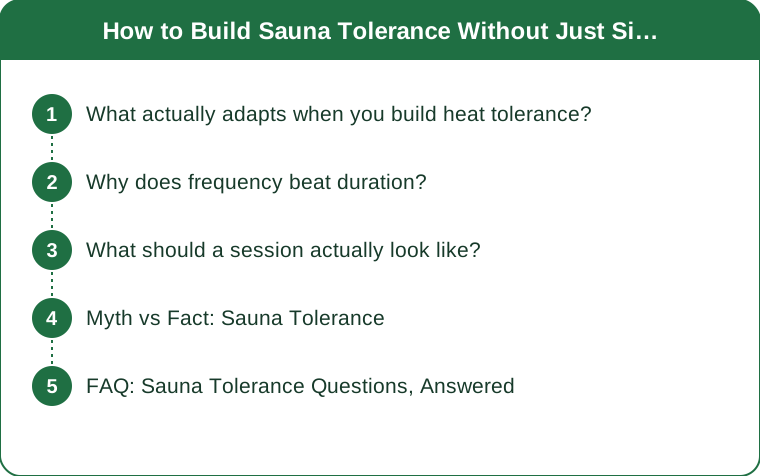
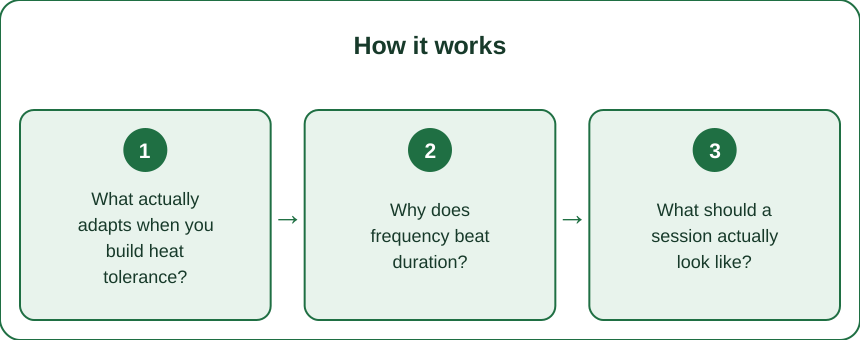
What actually adapts when you build heat tolerance?
Several distinct physiological changes, on different timelines, and knowing which is which explains most of the confusion.
Plasma volume expands, and it happens fast. Within three to six days of consistent heat exposure, your blood plasma volume increases meaningfully. More plasma means better cardiovascular stability under heat load, which is why the same session feels dramatically easier in week two than in week one.
Sweat onset happens earlier. An acclimated person starts sweating at a lower core temperature, which means cooling begins sooner and core temperature rises less. This is a genuine adaptation and it explains why experienced sauna users sweat almost immediately while beginners sit dry for several minutes.
Sweat becomes more dilute. Your body gets better at reabsorbing sodium before the sweat reaches the skin, which means you lose less salt for the same cooling. This takes longer, generally a couple of weeks.
Sweat rate increases overall. More total sweat means more evaporative cooling capacity, which raises the heat load you can tolerate before core temperature climbs.
Heart rate at a given temperature drops. This is the most noticeable subjective change and it is largely downstream of the plasma volume increase.
Most of it lands within seven to fourteen days of consistent exposure. The curve is steep at the start and then flattens, which is why the first two weeks feel transformative and month three feels like nothing is changing.
Why does frequency beat duration?
Because the adaptation signal is the repeated exposure to elevated core temperature, and each exposure is a separate signal.
Two 30-minute sessions and five 12-minute sessions total the same time. The five-session week produces considerably more adaptation, because adaptation responds to the number of stimulus events more than to their total duration.
Long sessions carry a disproportionate cost. Fluid loss, cardiovascular strain, and how wiped out you feel afterward all rise steeply past about fifteen to twenty minutes, while the additional adaptation signal rises very little.
Short sessions are far easier to actually do. A twelve-minute session fits into a day. A thirty-minute one requires planning, and the plan gets skipped. Consistency is the variable that produces results and short sessions protect it.
The practical progression: hold duration constant and add days. If you are doing two sessions of twelve minutes, go to three, then four, then five, all at twelve minutes. Only once you are at four or five sessions a week should you consider extending duration.
Consecutive days work better than spread-out days for building acclimation quickly. If you want fast adaptation, five to seven consecutive days produces most of the change. For maintenance afterward, three to four spread across the week is plenty.
And the adaptation fades. Plasma volume returns toward baseline within one to two weeks of stopping, which is why coming back after a holiday feels like starting over. It is not your imagination and it is not lost fitness.

What should a session actually look like?
Structured, with attention to the parts outside the hot room, which is where most people go wrong.
Hydrate before, not during. Drink 500ml of water in the hour beforehand. Drinking inside the sauna is not harmful but it does not keep up with losses, and arriving already down on fluid makes everything harder.
Start at eight to twelve minutes if you are new. Not until you feel bad. The goal is a stimulus, not an endurance test, and pushing to your limit in week one is the fastest route to associating the sauna with feeling terrible.
Sit on the lower bench first. Temperature stratifies dramatically in a sauna; the difference between the top and bottom bench can be 20 degrees Celsius or more. The lower bench is a genuinely different session and it is the right one to start on.
Cool down deliberately, not by wandering off. Two to five minutes of cool air or a cool shower brings your core temperature down in a controlled way. Skipping this is why some people feel unwell for an hour afterward.
Replace fluid and electrolytes after. You can lose half a litre to a litre in fifteen minutes. Water alone after heavy sweating dilutes sodium further; add a pinch of salt to your water or eat something salty.
Multiple rounds are optional and mostly about enjoyment. Two rounds of ten minutes with a proper cool-down between is a pleasant way to do it and there is no strong evidence it beats one round for adaptation.
And time it away from hard training if you can. Sauna immediately after a hard session compounds the cardiovascular and fluid stress. Separating them by a few hours, or using the sauna on easier days, is the more sustainable pattern.
Myth vs Fact: Sauna Tolerance
Myth: Longer sessions mean better adaptation. Fact: Frequency drives adaptation far more than duration. Five 12-minute sessions beat two 30-minute ones, and the long sessions carry disproportionately more fluid and cardiovascular cost.
Myth: If you are not sweating much, it is not working. Fact: Sweat onset timing is itself an adaptation. Beginners sweat later and less. Sitting there dry for five minutes in week one is normal and it changes within days.
Myth: Sauna sessions detoxify you. Fact: Sweat is over 99 percent water and electrolytes. Your liver and kidneys handle detoxification. The genuine benefits, cardiovascular adaptation and recovery, are real and do not need this framing.
Myth: You should push through until you cannot take it. Fact: The stimulus for adaptation is elevated core temperature, which you reach well before the point of distress. Pushing to your limit adds risk without adding much signal.
Myth: Tolerance you build lasts. Fact: Most of the adaptation, particularly plasma volume, fades within one to two weeks of stopping. This is why the first session back after a break feels so much harder.
Myth: The sauna is a weight loss tool. Fact: The weight lost is fluid and it returns within hours of rehydrating. Treating it as fat loss encourages under-drinking, which is genuinely risky.
One important note. If you are pregnant, have cardiovascular conditions, low blood pressure, or take medications affecting heart rate or fluid balance, talk to a doctor before regular sauna use. This is general information, not medical advice.
FAQ: Sauna Tolerance Questions, Answered
How often should you use a sauna to build tolerance?
Four to five shorter sessions a week beats two long ones. Most measurable adaptation, including plasma volume expansion and earlier sweat onset, occurs within seven to fourteen days of consistent exposure.
How long should a beginner stay in a sauna?
Eight to twelve minutes on the lower bench, not until you feel unwell. Add days to your week before you add minutes to your session, and expect the same duration to feel dramatically easier by week two.
Why do I sweat less than other people in the sauna?
Sweat onset is itself an adaptation. Acclimated people begin sweating at a lower core temperature, so they sweat almost immediately while beginners sit dry for several minutes. This changes within days of consistent exposure.
TL;DR:
- Frequency drives heat adaptation, not duration. Add days before you add minutes.
- Most of the change, including plasma volume and earlier sweat onset, lands within seven to fourteen consistent days.
- Start at eight to twelve minutes on the lower bench, hydrate beforehand, and cool down deliberately for two to five minutes.
- Replace sodium as well as water afterward, since you can lose a litre in fifteen minutes.
Adaptation fades within one to two weeks of stopping, so the hard first session back is physiology, not lost discipline.
Keep Reading
This article is for general informational purposes only and is not medical advice. Always consult a qualified health professional for guidance specific to you.