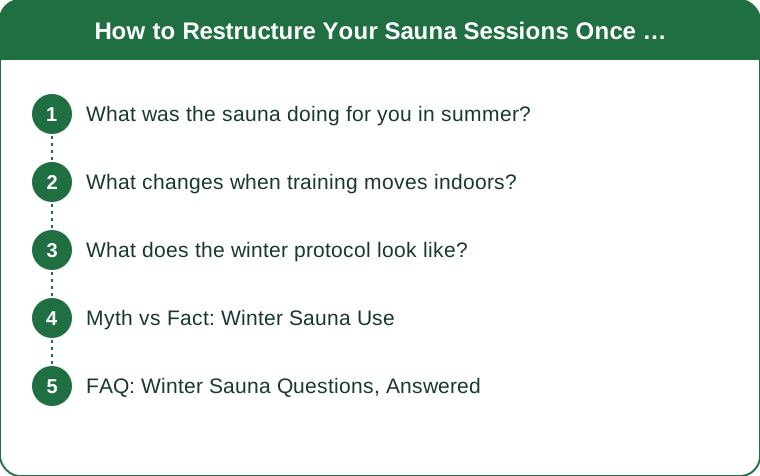
How to Restructure Your Sauna Sessions Once You Stop Training Outdoors
Quick Answer: In summer, sauna use largely adds to an existing heat load and is best kept short and well away from training. Once training moves indoors and outdoor heat exposure disappears, the sauna becomes your primary heat stimulus — which means longer, more frequent sessions become both safe and more useful.
You kept sauna sessions short all summer because you were already hot most of the time.
Your training has moved indoors, the outdoor heat is gone, and you are still running the same ten-minute session.
The context that made that session correct no longer exists.

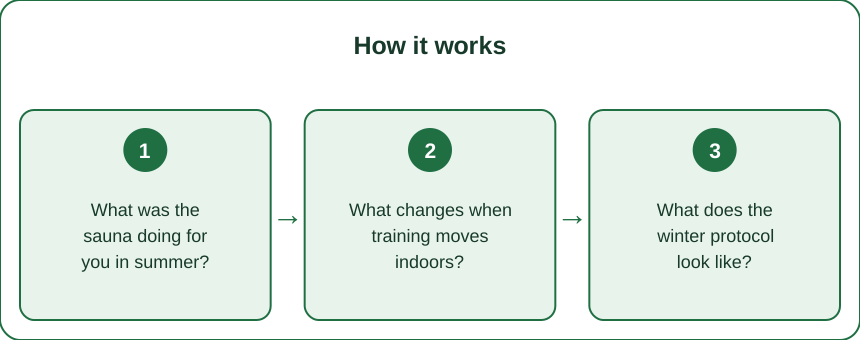
What was the sauna doing for you in summer?
Mostly recovery and habit, with a small and largely redundant heat-adaptation effect.
Heat adaptation — the plasma volume expansion and improved thermoregulation that come from repeated heat exposure — is a real and useful adaptation, but it responds to total heat exposure rather than to sauna specifically. A summer of training outdoors in warm conditions is already providing that stimulus in quantity.
So the summer sauna session was doing three things: a modest additional recovery effect, a mental wind-down, and not much heat adaptation because you were already adapted.
That is why short sessions made sense. Adding a large heat load on top of an already-warm day and a hot training session is a genuine cardiovascular stress, and the marginal benefit was small because the adaptation was already saturated.
Take the summer away and two of those three constraints disappear at once.
What changes when training moves indoors?
Your total heat exposure collapses. Indoor training in a climate-controlled gym at 18 to 20C produces a fraction of the thermal load of an outdoor session in August, and the heat adaptation you built over the summer begins to decay within about two to three weeks of removal.
That decay is worth caring about for a specific reason: plasma volume expansion, one of the main adaptations from heat exposure, is also relevant to endurance performance in cool conditions. Losing it over winter means arriving at spring with less than you had.
The sauna is now the only meaningful heat stimulus you have. Its role has shifted from a small addition to a primary input, which justifies a substantially different protocol.
There is also a seasonal-mood dimension worth naming honestly. The evidence for sauna use and subjective wellbeing is reasonable if not spectacular, and for many people the value of a regular warm, quiet twenty minutes through a dark winter is not really about plasma volume at all.

What does the winter protocol look like?
Longer sessions, more of them, and positioned differently in the week.
Duration: work up to 15 to 20 minutes per session at 80 to 90C, versus the 8 to 12 you may have been doing. Build gradually — add two minutes per week rather than jumping.
Frequency: three to four times per week is where most of the observed benefits in the research cluster. Once a week is pleasant and does very little for adaptation.
Timing relative to training: post-session is fine and often ideal in winter, 30 to 60 minutes after finishing. The summer caution about stacking heat loads matters much less when the training session itself was not hot.
Structure: two rounds works better than one long one for most people. 12 minutes in, 5 minutes cooling and rehydrating, 8 to 10 minutes back in. The cooling round is not optional — it is part of the stimulus, not a break from it.
Hydration: 500 ml before, 500 ml after, minimum. Winter thirst is blunted, and sauna fluid loss is not.
This is general information, not medical advice. Anyone with cardiovascular conditions, low blood pressure, or who is pregnant should speak to a doctor before increasing sauna use.
Myth vs Fact: Winter Sauna Use
Myth: The sauna is for after hard sessions only. Fact: Frequency drives the adaptation, so sessions on rest days count fully. In winter, rest-day sauna use is arguably the more valuable slot because it does not compete with post-training recovery.
Myth: Longer is always better. Fact: Benefits plateau and cardiovascular strain does not. Past about 20 minutes per round for most people, you are accumulating stress without much additional adaptation.
Myth: Sauna use replaces a cool-down. Fact: It does not. Heat does nothing for the gradual reduction in heart rate and the light movement that a cool-down provides. Cool down first, then use the sauna.
Myth: You should push through until you feel you cannot take any more. Fact: The adaptation responds to core temperature elevation, which happens well before the point of distress. Sessions ending in genuine discomfort produce no more benefit and considerably worse adherence.
FAQ: Winter Sauna Questions, Answered
How long until I feel a difference?
Heat adaptation markers appear within about two weeks of consistent exposure at three to four sessions weekly. Subjective effects like sleep quality and wind-down tend to appear sooner, often in the first week.
Is an infrared sauna equivalent?
Not quite. Infrared operates at lower ambient temperatures and produces a smaller core temperature rise, so sessions need to be longer for a comparable stimulus. It is not useless — it is simply a weaker dose per minute.
Can I sauna on the same day as a hard session and a cold plunge?
Yes, but order matters. Hard session, cool down, sauna, then cold if you want it. Cold immediately after training may blunt some strength adaptations, so putting the sauna between them is both more pleasant and probably wiser.
TL;DR:
- Summer sauna sessions were short because you were already heat-adapted and heat-loaded from outdoor training.
- Indoor winter training removes that stimulus, and heat adaptation decays within two to three weeks.
- Move to 15 to 20 minutes, three to four times weekly, ideally as two rounds with a cooling break.
- Rest-day sessions count fully, and hydration matters more in winter because thirst is blunted.
The sauna did not change and neither did you. What changed is that it went from being one of several sources of heat in your week to being the only one — and a protocol built for the first situation is leaving most of the benefit on the bench in the second.
Keep Reading
This article is for general informational purposes only and is not medical advice. Always consult a qualified health professional for guidance specific to you.