Why Your Sauna Session Should Change When Your Training Load Does
Quick Answer: Sauna use raises heart rate, increases cardiovascular strain and produces meaningful fluid loss - all of which add to, rather than subtract from, total weekly stress. In a heavy training block, shorten sessions and move them away from hard workouts; in a deload or easy week, longer sessions are far better tolerated. The fixed twenty-minute daily habit is what turns a helpful practice into an extra load precisely when you can least absorb it.
You kept the sauna routine identical through your hardest training month.
That is not a constant. It is a variable you left unmanaged.

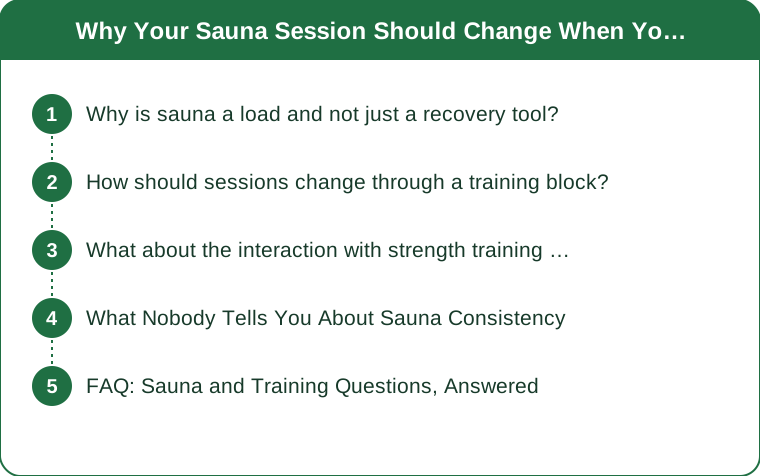
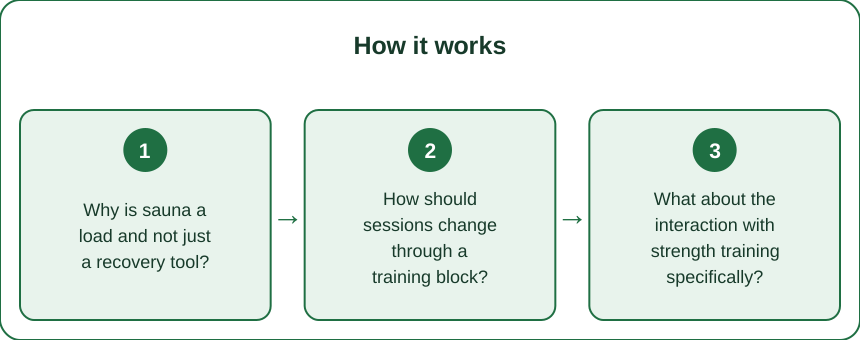
Why is sauna a load and not just a recovery tool?
Heart rate rises substantially during sauna use, with commonly reported increases that put it in a range comparable to moderate physical activity.
Cardiovascular strain is real, which is part of why the observational research on regular sauna use and cardiovascular outcomes is interesting - the same reason it is a stressor.
Fluid loss is significant, frequently a pound or more of sweat in a single session, and dehydration compounds with training-induced fluid loss.
Core temperature rises, and the body’s response to that is an active physiological process rather than passive rest.
Which means total weekly stress includes sauna, and a heavy training week plus an unchanged sauna routine is a higher total than either alone.
None of this argues against sauna use. It argues for adjusting the dose the same way you adjust training volume.
How should sessions change through a training block?
Build weeks with high volume: shorter sessions, 8 to 12 minutes, and fewer per week.
Peak or intensity weeks: keep sauna away from hard sessions entirely, or drop it to once or twice.
Deload and easy weeks: this is where longer sessions fit, 15 to 20 minutes, and where the practice is best tolerated.
After a hard session, wait rather than going straight in. Give yourself time to rehydrate and let heart rate settle first.
Never sauna immediately before a hard training session, which raises core temperature and fluid deficit going into work that needs both to be normal.
Reduce or skip if sleep has been poor, since heat tolerance drops noticeably with sleep debt.
And treat illness and heavy travel as automatic skip conditions. This is general information, not medical advice.

What about the interaction with strength training specifically?
Sauna after strength training is generally well tolerated and is where most people naturally place it.
Some research has explored whether heat exposure immediately after training affects adaptation, with mixed and context-dependent findings - it is not settled enough to build a rule on.
What is clearer is the practical side: a session that leaves you dehydrated and lightheaded compromises the next day’s training regardless of any adaptation question.
Rehydrate before the sauna, not only after. Going in already down on fluid from a session is the most common practical error.
Include electrolytes if sessions are long or frequent, since sweat contains sodium as well as water.
And note that standing up too fast after a session causes dizziness because of peripheral blood vessel dilation - stand slowly and sit outside for a few minutes before showering.
What Nobody Tells You About Sauna Consistency
Heat tolerance is trainable and it detrains. Two weeks away and the same session feels considerably harder, which people often interpret as being unwell or unfit rather than as a normal loss of heat acclimation.
Your tolerance varies within a single week, tracking sleep, hydration, alcohol, training load and menstrual cycle position. A twenty-minute session is a completely different challenge on a Tuesday after a rest day than on a Friday after four hard sessions.
The bench you sit on matters more than the thermostat. Air temperature stratifies sharply in a sauna, so the top bench can be a great deal hotter than the bottom - which means the same room delivers wildly different sessions depending on where you sit.
Fluid loss is much larger than most people estimate. Weighing yourself before and after a couple of sessions gives you a real number, and most people are surprised by it - which matters most in exactly the weeks their training is already demanding.
The cool-down does a substantial share of the work. The ten minutes after leaving the sauna, when heart rate settles and blood redistributes, is a real part of the practice rather than an afterthought, and rushing straight into a cold shower and out the door skips it.
Timing relative to sleep matters. A sauna session too close to bedtime can raise core temperature at the wrong point in the cycle for some people, while an earlier evening session often helps sleep - the difference is a couple of hours.
And more is not automatically better. The observational research most often cited involves regular, moderate use over years, not maximal daily exposure - which is a very different pattern from the one people adopt when they get enthusiastic. This is general information, not medical advice.
FAQ: Sauna and Training Questions, Answered
Should I use the sauna on hard training days?
Generally keep it away from your hardest sessions, or shorten it considerably. Sauna adds cardiovascular strain and fluid loss to a day that already has both.
How long should a session be?
It depends on the week. 8 to 12 minutes during heavy training blocks; 15 to 20 in easy or deload weeks. A fixed duration across all weeks ignores the variable that matters.
Sauna before or after a workout?
After, with time to rehydrate first. Before a hard session, it raises core temperature and fluid deficit going into work that needs neither.
Why does the same session feel harder some weeks?
Heat tolerance tracks sleep, hydration, alcohol, training load and cycle position. It is one of the more variable things people treat as fixed.
How much fluid do I actually lose?
Often a pound or more per session. Weigh yourself before and after twice to get a real figure, and rehydrate to match.
Should I skip the sauna if I slept badly?
Usually yes, or shorten it substantially. Heat tolerance drops noticeably with sleep debt and the session will cost more than it returns. This is general information, not medical advice.
TL;DR:
- Sauna raises heart rate, strains the cardiovascular system and causes real fluid loss - it adds to weekly stress.
- Shorten sessions in heavy training blocks; save longer ones for deload and easy weeks.
- Keep sauna away from your hardest sessions and never immediately before them.
- Heat tolerance is trainable, detrains in about two weeks, and varies within a single week.
- The bench you sit on changes the session more than the thermostat does.
- Skip or shorten after poor sleep, illness or heavy travel.
Adjust the sauna dose the way you adjust training volume. This is general information, not medical advice.
Keep Reading
This article is for general informational purposes only and is not medical advice. Always consult a qualified health professional for guidance specific to you.