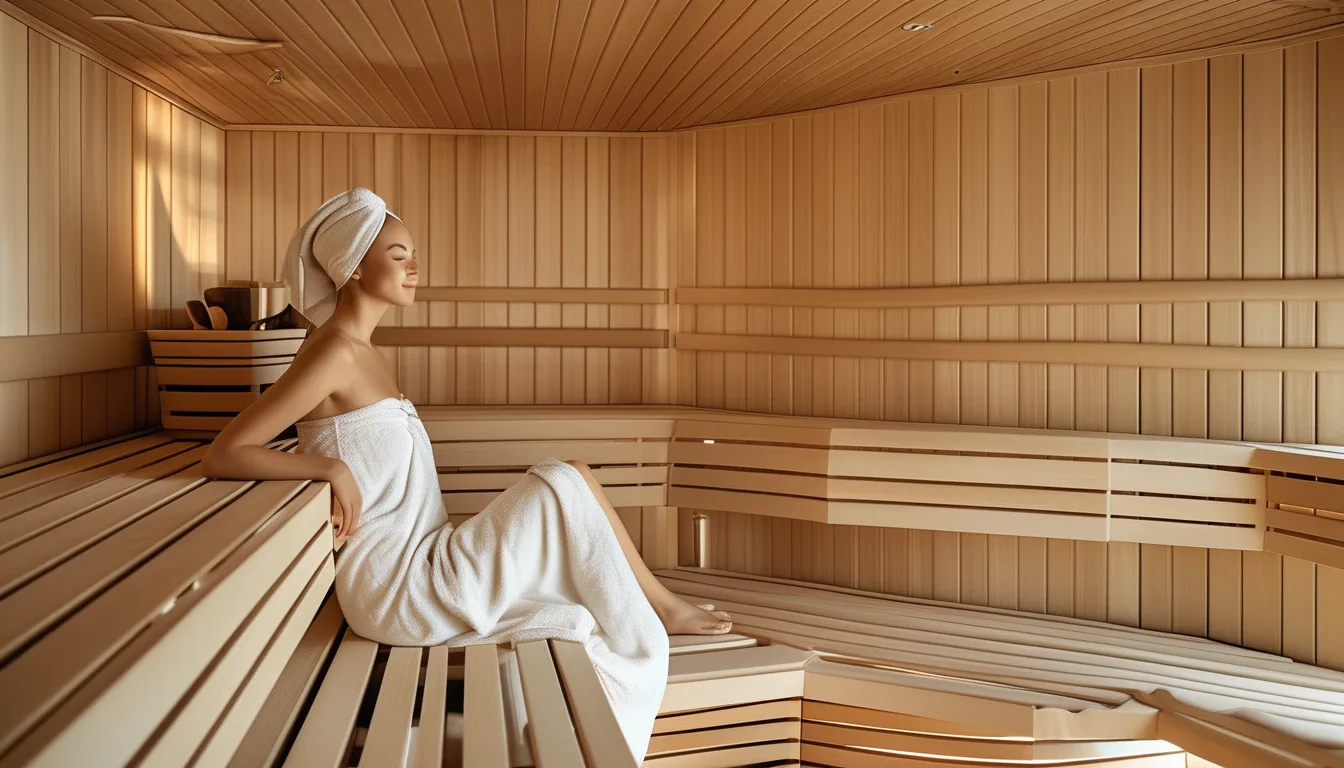
The Bench You Choose Changes Your Sauna More Than the Thermometer Does
Quick Answer: Heat stratifies strongly in a sauna — the top bench can be 25-35°F hotter than the bottom, and the thermometer usually sits near the top. Your bench choice changes your effective temperature, your heart rate response, and your tolerable session length more than adjusting the heater would. Sitting versus lying down changes it again.
Your friend said the sauna was at 180. You sat down and it felt fine. They sat one row up and were out in eight minutes.
Same room, same session, roughly a 30-degree difference in what each of you was doing.

How much does the temperature actually vary by height?
A lot more than most people expect, because hot air rises and a sauna is a small enclosed space with a heat source near the floor.
Typical stratification in a traditional Finnish-style sauna running at 180°F on the top bench:
- Top bench (head height when seated): 175-190°F
- Middle bench: 155-170°F
- Bottom bench: 140-160°F
- Floor: 105-120°F
So the difference between the top and bottom bench is routinely 30-40°F. That is a bigger range than most people would ever deliberately adjust their heater across.
There is also a vertical gradient across your own body. Sitting upright on the top bench, your head may be in air 20°F hotter than your feet. This is why sitting with your feet up on the bench feels meaningfully hotter than sitting with them on the floor — you have moved your lower body into a warmer layer.
Where is the thermometer, and why does that matter?
Almost always mounted high on the wall, near the top bench level, well away from the heater.
That placement is standard for a reason — it reports the hottest usable zone. But it means the posted number describes a specific spot that many people in the room are not occupying. If you are on the bottom bench, the wall might say 190 while you are experiencing something closer to 150.
This explains a common confusion. People report that a sauna ‘at 180’ at one facility feels far hotter than another at the same reading. Usually the difference is bench geometry — a room with a high top bench and a low ceiling stratifies differently from one with wide low benches — plus humidity, which changes perceived heat dramatically.
The practical implication: choose your bench by how you feel, and use the number only to compare a room against itself. Comparing posted temperatures across facilities tells you very little.
Does lying down change anything?
Substantially, and it is the adjustment most people never consider.
Lying flat on the top bench puts your whole body in the same thermal layer, which means your feet are as hot as your head. That is a more even and often more comfortable heat, and it is the traditional way to use a sauna in Finland where space allows.
It also changes circulation. Lying down reduces the cardiovascular demand of heat exposure somewhat — your heart is not working against gravity to maintain blood pressure while peripheral vessels are dilated. This is part of why people feel less lightheaded lying down and why standing up quickly from a lying position in a hot room is the moment dizziness is most likely.
Sitting upright on a high bench is the most demanding common position: maximum heat at the head, maximum cardiovascular load. If a session feels harder than it should, moving down one bench or lying flat will change the experience more than shortening it by two minutes.

Myth vs Fact: Sauna Temperature
Myth: Hotter is better. Fact: the research on sauna and cardiovascular outcomes is built largely around frequency and duration, not extreme temperature. Regular moderate sessions look better than occasional punishing ones on essentially every measure people care about.
Myth: The bottom bench does not count. Fact: 150°F for twenty minutes produces a substantial core temperature rise and a meaningful cardiovascular response. Sitting low is not a lesser version of the sauna, it is a longer, gentler dose of it.
Myth: You should always aim for the top bench eventually. Fact: bench height is a preference, not a progression. Plenty of long-term sauna users sit mid-bench permanently because it lets them stay in longer, which is the variable that matters more.
Myth: The thermometer tells you the humidity too. Fact: it tells you nothing about it, and humidity changes perceived heat enormously. A 160°F room after water on the rocks can feel far more intense than a dry 190°F room.
How should you choose a bench for your goal?
For relaxation and a longer session: middle or bottom bench, 15-25 minutes, sitting or lying. The lower thermal load lets you stay long enough for the parasympathetic shift to actually settle in.
For a shorter, more intense heat exposure: top bench, 8-15 minutes, expect a heart rate response similar to moderate exercise.
If you are new: bottom bench, 5-10 minutes, and go up a bench next time rather than adding time. Changing one variable at a time makes it much easier to find your range.
After a hard training session: middle bench. The top bench on top of an already elevated heart rate and a dehydrated state is where people get into trouble.
If you feel lightheaded at any point: move down, then out, then sit outside the room for a few minutes before standing fully. Do not push through it.
A general caution: if you are pregnant, have cardiovascular conditions, low blood pressure, or take medication affecting blood pressure or sweating, talk to your doctor before regular sauna use. This is general information, not medical advice.
FAQ: Sauna Bench Questions, Answered
Should I put my feet up on the bench?
Yes, if there is room. Sitting with feet on the floor puts your lower legs in air that can be 40°F cooler than your head, which produces an uneven, less comfortable heat and an uneven sweat response. Feet up on the bench you are sitting on is the standard position for a reason.
Why does the same bench feel different at the start and end of a session?
Partly you are heating up, but also the room itself is changing. Every time someone opens the door, the hottest air escapes first and the stratification resets, taking several minutes to rebuild. In a busy public sauna the top bench can vary by 20°F across a fifteen-minute session purely from door traffic.
Is the seat under the vent better or worse?
Usually worse for consistency. Air movement across your skin increases evaporative cooling, so a spot near an intake vent feels cooler than the thermometer suggests, and a spot in the exhaust path can feel hotter. If a particular seat in your regular sauna feels off compared to its neighbours, airflow is almost always why.
TL;DR:
- Top and bottom benches routinely differ by 30-40°F; the thermometer usually reports the top.
- Your own body sits in a gradient too — feet on the floor can be 40°F cooler than your head.
- Lying flat evens the heat and reduces cardiovascular load; sitting high is the most demanding position.
- Choose bench by goal: lower and longer for relaxation, higher and shorter for intensity.
- Compare posted temperatures only within the same room — across facilities they mean very little.
The adjustment worth trying on your next visit is the cheapest possible one: move down a bench and stay five minutes longer. Most people find the session more pleasant, more sustainable, and — because duration is doing more work than peak temperature — not obviously less effective.
Keep Reading
This article is for general informational purposes only and is not medical advice. Always consult a qualified health professional for guidance specific to you.