Why the Bench You Sit On Changes Your Session More Than the Thermostat
Quick Answer: Hot air rises, so a sauna is strongly stratified — the top bench commonly runs 25-35°F hotter than the bottom one in the same room. The thermostat reading usually reflects a sensor near the top. That means your bench choice changes your actual exposure more than adjusting the dial does, and it’s the main reason the same sauna feels wildly different session to session.
You set it the same, sat for the same fifteen minutes, and it felt twice as intense as last time. Check where you sat. That variable is almost always bigger than the one on the control panel.

How much does the temperature actually vary by height?
More than most people assume, and it’s a steep gradient rather than a gentle one.
In a typical sauna, air near the ceiling can be 25-35°F hotter than air near the floor. In a taller room or one with a powerful heater, the spread can be larger. The gradient isn’t linear either — most of the change happens in the upper third of the room.
The sensor position matters for interpretation. Most saunas mount the thermostat sensor high, near the ceiling, which means the displayed number reflects the hottest air in the room, not the air where you’re sitting. A sauna reading 180°F may be delivering closer to 150°F at the lower bench.
Practical implication: moving from the bottom bench to the top is a bigger change to your session than turning the dial up 20 degrees. And moving down is the fastest way to moderate a session that’s become too intense, without leaving the room.
Why does this explain session-to-session variation?
Because bench position is the variable people change most often without noticing.
You sit where there’s room. On a quiet evening you take the top bench because it’s free. On a busy one you take the bottom. Same duration, same setting, dramatically different heat exposure — and since nobody records where they sat, the variation gets attributed to sleep, hydration, or fitness.
Those things genuinely matter too. But bench position is usually the largest single variable, and it’s the only one that’s completely under your control.
The consistency approach
If you’re trying to build a repeatable practice, fix your bench position first, before you standardize anything else. Sitting on the same bench each session removes the biggest source of noise, and only then can you tell whether hydration or timing is affecting things.
Then use position as your progression variable. Rather than extending duration to increase the stimulus, move up a bench at the same duration. It’s a cleaner progression than adding minutes, and it doesn’t extend your total time commitment.

How should you actually use the benches?
A structure that works well for most people.
New to sauna, or returning after a break: bottom bench, 8-12 minutes. The lower bench is where heat tolerance builds, and starting on top is the most common reason people conclude they don’t like saunas.
Building tolerance: bottom bench, extending to 15 minutes, then move to the middle at the shorter duration and rebuild. Progress by height, not by time.
Established practice: top bench, 10-20 minutes depending on tolerance. Beyond about 20 minutes at high heat, the returns flatten and the risk profile changes.
Recovery-focused sessions after hard training: lower bench, longer. Heavy heat stress on top of heavy training stress isn’t additive in a useful way.
The mid-session move
Starting on top and moving down after several minutes is a legitimate approach — it front-loads the intensity while letting you extend total time. Moving from bottom to top mid-session works less well, because you’re adding heat load when you’re already partly depleted.
What Nobody Tells You About Sauna Position
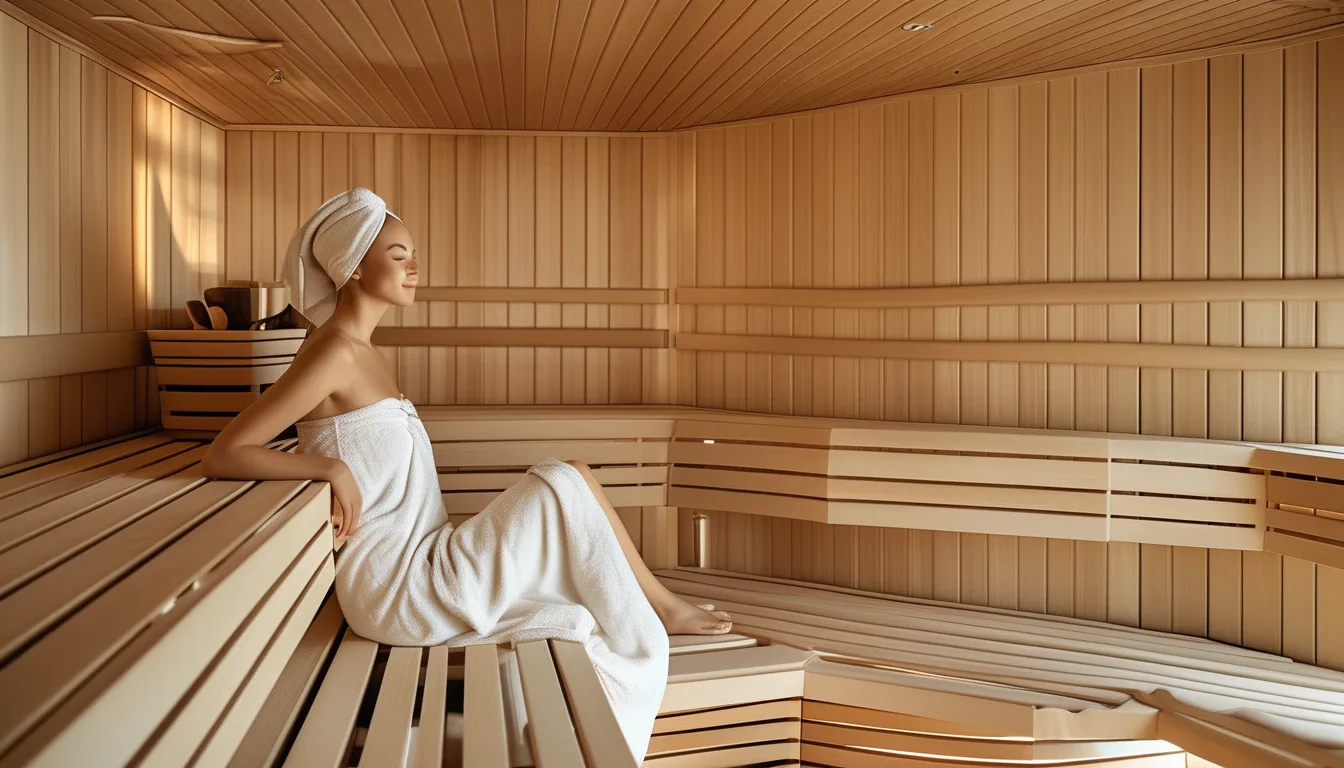
Feet-up matters as much as bench height. Sitting on the top bench with your feet on the bottom one puts your legs in significantly cooler air than your head — an uneven exposure that many people find more uncomfortable than uniform higher heat. Getting your feet onto the bench you’re sitting on evens it out considerably.
Lying down is a different exposure entirely. Horizontal on the top bench means your whole body is in the hottest layer, which is more intense than sitting on the same bench. If a sauna is quiet enough to lie down, treat it as a step up.
Proximity to the heater is a second gradient. Beyond height, radiant heat from the stove drops off with distance. The far corner of the top bench is meaningfully milder than the spot directly above the heater.
Humidity stratifies too. After water is thrown on the stones, the steam rises fast — the top bench experiences a much sharper humidity spike than the bottom, which is why löyly feels dramatically more intense up there.
Seasonal note: as outdoor temperatures fall through autumn, the sauna’s lower benches cool faster than the upper ones, because cold air infiltration settles at floor level. The gradient gets steeper in winter, meaning your usual bottom-bench session may feel milder in January than it did in August at the same setting.
FAQ: Sauna Bench Questions, Answered
Is the top bench better for the health benefits?
The research on sauna use mostly measures frequency and duration rather than intensity. Consistent sessions at a tolerable temperature appear to matter more than maximizing heat.
How do I know if I’m on too hot a bench?
If you’re counting down the minutes rather than settling, you’re too hot. A well-matched session should be tolerable enough that time passes without effort.
Should I move down instead of leaving early?
Yes — it’s the better option in nearly every case. Moving down lets you complete the session at a manageable exposure rather than cutting it short.
Does the thermostat reading mean anything useful then?
As a relative measure between visits to the same sauna, yes. As an absolute measure of what you’re experiencing, not really.
Why does the same bench feel different in different saunas?
Ceiling height, heater power, and ventilation all change the gradient’s steepness. A top bench in a low-ceilinged sauna may be milder than a middle bench in a tall one.
TL;DR:
- Top and bottom benches commonly differ by 25-35°F in the same room
- The thermostat sensor usually sits high, so the display overstates what you’re experiencing lower down
- Fix your bench position before standardizing anything else about your practice
- Progress by moving up a bench rather than by adding minutes
- Feet on the same bench you’re sitting on, and expect steeper gradients as winter arrives
If your sauna sessions feel unpredictable, the most likely explanation is a variable you’ve never tracked. Pick a bench, stay on it, and the rest becomes measurable. This is general information, not medical advice — check with a doctor before starting regular sauna use if you have cardiovascular conditions.
Keep Reading
This article is for general informational purposes only and is not medical advice. Always consult a qualified health professional for guidance specific to you.