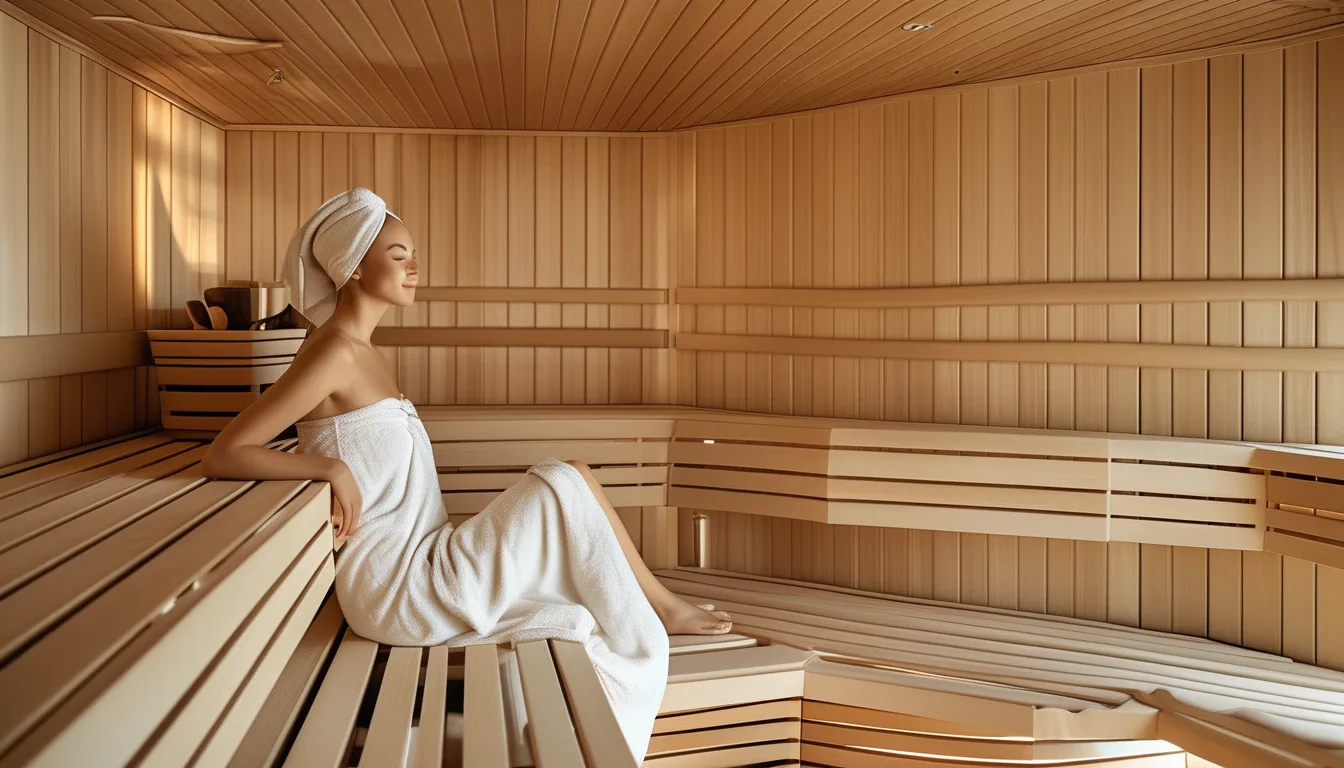
Why Your Sauna Session Feels Harder Once the Weather Cools Down
Quick Answer: Heat acclimation is built and lost quickly. Through summer, daily exposure to hot conditions raised your plasma volume and made you sweat earlier and more efficiently. As the weather cools, those adaptations start reversing within about a week and decay substantially over two to three weeks, so the same sauna session at the same temperature genuinely becomes harder.
All summer, fifteen minutes was easy. The first properly cool week arrives and the same fifteen minutes at the same temperature has you counting down from minute eight. The sauna did not change.

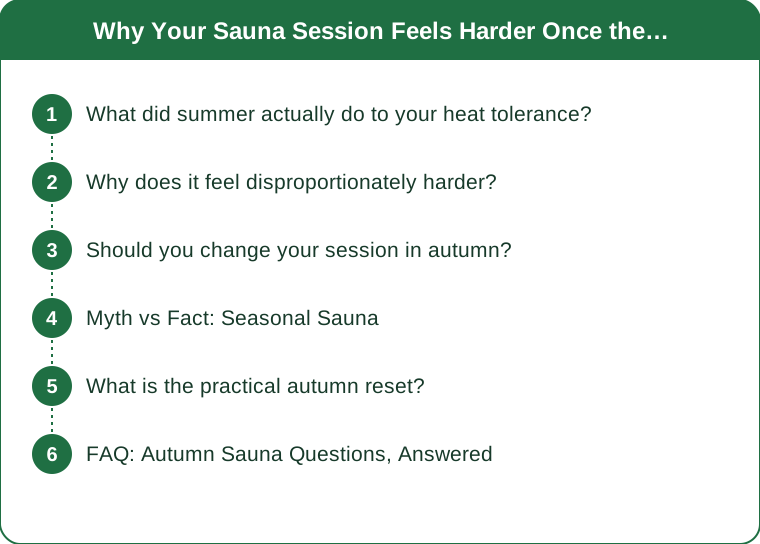
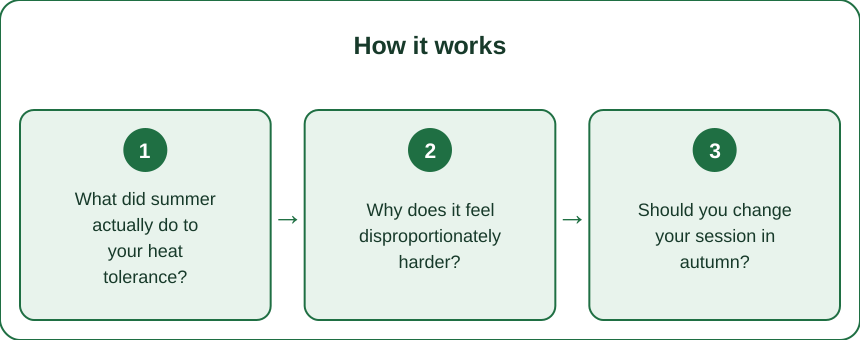
What did summer actually do to your heat tolerance?
It produced a set of real physiological adaptations, and they are the reason the sauna felt easy in July.
Plasma volume increases with repeated heat exposure, typically within the first week or so. More plasma means better cardiovascular stability under heat load — your heart rate stays lower for the same thermal stress, which is most of what makes a session feel manageable.
You start sweating earlier and at a lower core temperature. An acclimated person begins cooling themselves sooner, so core temperature rises more slowly.
Sweat becomes more dilute. The body conserves sodium more effectively when acclimated, which matters over repeated sessions.
The important part: these are not permanent. Heat acclimation decays when the stimulus is removed, and the decay is on a similar timescale to the adaptation — noticeable within about a week, substantial over two to three. Summer was providing that stimulus for free through ambient temperature, on top of whatever the sauna was doing.
Why does it feel disproportionately harder?
Because the change is happening in your cardiovascular response, which is the part you feel most directly.
With reduced plasma volume, your heart rate climbs faster for the same heat load. Heart rate is closely tied to perceived exertion, so a session that produces a higher heart rate feels harder even at an identical temperature and duration.
The delayed sweat onset compounds it. If you start sweating two minutes later, you spend those two minutes with core temperature rising faster, which means you arrive at minute eight in a warmer state than you used to.
There is also a starting-condition effect that is easy to overlook. In summer you entered the sauna already warm; skin temperature was high and peripheral blood vessels were already dilated. In autumn you enter cold, with constricted peripheral circulation, and the first few minutes are spent getting to a state you used to arrive in.
That last one is fixable in a way the others are not — a warm shower before entering, or a session after training rather than cold, removes a real part of the difficulty.
Should you change your session in autumn?
Yes, in the same way you would adjust any training variable when your capacity changes.
Reduce duration before reducing temperature. A shorter session at your usual temperature preserves the stimulus better than a longer one at a lower temperature. Ten to twelve minutes instead of fifteen is a reasonable autumn reset.
Increase frequency if you can. Acclimation responds to frequency more than to session length. Three shorter sessions a week maintain more adaptation than one long one, and the maintenance requirement is lower than the acquisition requirement.
Enter warm. After exercise, or after a warm shower. This removes the cold-start penalty and makes the session feel closer to what it was.
Rebuild over two to three weeks rather than forcing it. Reacclimation is faster than the original acclimation, but it is not instant. Adding a minute or so per week gets you back without the sessions being unpleasant.
And the honest caveat: sauna use raises heart rate and cardiovascular load meaningfully, and dehydration or standing up too fast can cause dizziness or fainting. This is general information rather than medical advice — if you have a cardiovascular condition, are pregnant, or are on medications that affect blood pressure or fluid balance, that is a conversation to have with a doctor rather than a question to resolve by feel.
Myth vs Fact: Seasonal Sauna
Myth: Your heat tolerance is a fixed trait. Fact: It is a trainable adaptation with a fast onset and a fast decay. People who tolerate heat well are usually people with recent heat exposure, and that includes ambient summer conditions rather than only deliberate training.
Myth: The sauna is more valuable in winter because you are cold. Fact: It is arguably more pleasant in winter and the physiological effects are the same year-round. What changes is your baseline acclimation, which is lower — meaning the same session is a larger relative stress in winter, not a smaller one.
Myth: You should push through and it will come back faster. Fact: Reacclimation responds to consistent, tolerable exposure. Sessions that leave you feeling awful reduce the likelihood you do the next one, and frequency is the variable that matters most. Comfortable and repeated beats heroic and sporadic.
Myth: Sweating less means the session is not working. Fact: In autumn you sweat later and possibly less, which reflects reduced acclimation rather than reduced effect. Sweat volume is a poor proxy for the cardiovascular and thermal stimulus you are actually getting.
Myth: Hydration only matters in summer. Fact: People drink noticeably less water in cool weather because thirst drops, while sauna fluid losses stay the same. Autumn is when sauna dehydration is most likely, not least.
What is the practical autumn reset?
Five adjustments, all small.
- Cut duration by about twenty percent for two weeks, then rebuild by a minute a week until you are back where you were
- Enter warm — after training, after a warm shower, or after any activity. The cold start is a bigger factor than it seems
- Hydrate deliberately rather than by thirst. Thirst is a less reliable signal in cool weather, and you are losing the same fluid as in July. A glass before and a glass after, with something containing sodium if you sauna often
- Keep the frequency up rather than protecting the length. Three ten-minute sessions beat one twenty-minute session for maintaining adaptation
- Sit lower on the bench for the first sessions. Bench height changes the effective temperature substantially — the difference between the top and bottom bench in a well-built sauna is large, and it is a finer adjustment than changing the thermostat
One more thing worth knowing for the season ahead: the cold plunge or cold shower afterward feels dramatically different once ambient temperature drops. A contrast session that was refreshing in August is a genuine shock in November, and building that back up gradually is the same principle in the other direction.
FAQ: Autumn Sauna Questions, Answered
How long does it take to get my tolerance back?
Reacclimation is generally faster than the initial adaptation — most of the plasma volume response comes back within about a week of consistent exposure, with the fuller picture over two to three weeks. Consistency matters more than intensity during that window.
Is it worth using the sauna at all if I am not acclimated?
Yes. The cardiovascular and relaxation effects are present regardless of acclimation status; what changes is how hard the session feels and how long you can comfortably stay. Shorten the session rather than skipping it, and the tolerance rebuilds as a side effect.
Why do I get dizzy standing up more often in cool weather?
Partly reduced plasma volume, partly the fact that people drink less water when it is cold, and partly the larger temperature gradient when you step out of the sauna into a cool room. Stand up slowly, sit on the bench for thirty seconds before standing, and cool down gradually rather than stepping straight into cold air. If dizziness is frequent or severe, that is worth raising with a doctor.
TL;DR:
- Heat acclimation is built and lost fast — summer’s ambient heat was doing part of the work for you
- Reduced plasma volume raises your heart rate for the same session, which is why it feels disproportionately harder
- Cut duration by about twenty percent for two weeks, keep frequency up, and rebuild a minute at a time
- Enter warm, hydrate deliberately despite lower thirst, and use bench height as a fine adjustment
The sauna is the same temperature it was in July. You are the variable that changed, and it changes back on a two to three week timeline once you keep showing up.
Keep Reading
This article is for general informational purposes only and is not medical advice. Always consult a qualified health professional for guidance specific to you.