Why Your Sweat Starts Later in the Sauna Than Everyone Else's
Quick Answer: Sweat onset depends on core temperature rise, not air temperature, so anyone who arrives with a slightly cooler core, lower hydration, or less heat acclimation will start sweating 2 to 5 minutes later than a regular user. It is not a sign of poor fitness or a slow metabolism. Sitting on a lower bench, arriving dehydrated, or coming straight from air conditioning all push the start line back.
You sit down. Four minutes pass. The person across from you looks like they walked through a sprinkler, and you have exactly one bead of sweat behind one knee. It feels like a scoreboard. It isn’t one — and the third reason on this list surprises people who have been going for years.
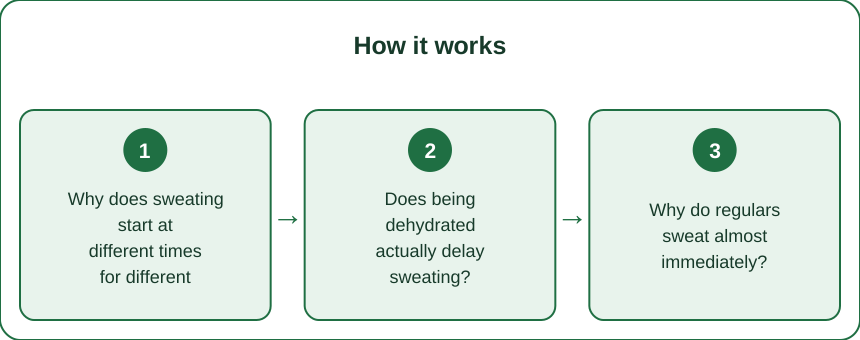
Why does sweating start at different times for different people?
Your body doesn’t sweat because the room is hot. It sweats because your core temperature has risen roughly 0.3 to 0.6°F above baseline and the hypothalamus decides cooling is now the priority.
That means everything sits upstream of the sweat: how warm you were walking in, how much blood volume you have available to carry heat to the skin, and how quickly your skin blood vessels open. Someone who biked over in the sun starts the clock already halfway there. You, coming from a 68°F office, are starting from zero.
A 2 to 5 minute spread between two healthy people in the same room is completely normal, and it says almost nothing about either person’s fitness.
Does being dehydrated actually delay sweating?
Yes, and it’s the single most common cause. Sweat is made from plasma, and plasma volume is the first thing to drop when you’re under-hydrated.
When blood volume runs low, your body protects blood pressure first and cooling second. It’ll hold onto fluid longer, delay sweat onset, and then dump it all at once later — which is why some sessions feel like nothing for six minutes and then unbearable for two.
The fix is boring and it works: 16 to 20 oz of water in the 60 to 90 minutes before you go in, not chugged at the door. Water you drank two minutes ago is still in your stomach, not in your plasma.
Why do regulars sweat almost immediately?
Heat acclimation is a real, measurable adaptation, and it happens fast — most of it lands within 7 to 10 exposures over two weeks.
What changes: plasma volume rises by roughly 5 to 10 percent, sweat glands become more responsive, and the temperature threshold that triggers sweating drops. An acclimated person starts sweating sooner, sweats more, and sweats more dilutely (losing less sodium per session).
So the person dripping at minute two isn’t tougher than you. They’re two weeks ahead of you on a curve you’re already climbing. If you’ve been going once every ten days, you’re restarting that curve each time.
Myth vs Fact: Sauna Sweat Edition
Myth: Sweating more means the sauna is working better. Fact: Sweat volume tracks acclimation and hydration, not benefit. The cardiovascular response — raised heart rate, dilated vessels — happens whether you’re visibly dripping or not.
Myth: If you’re not sweating, you’re not getting hot enough, so stay longer. Fact: Core temperature is still climbing during the dry phase. Extending a session to force visible sweat is how people get lightheaded.
Myth: Slow sweaters have a slow metabolism. Fact: Resting metabolic rate has essentially nothing to do with sweat onset. Body surface area, hydration, and acclimation do.
Myth: A hot shower first is cheating. Fact: It’s a legitimate way to pre-warm your skin and shorten the lag. Nothing is being graded here.
What changes sweat onset that has nothing to do with you?
Where you sit matters more than most people realize. In a traditional sauna, the temperature difference between the top and bottom bench is commonly 25 to 40°F. Sitting one row down is a genuinely different session.
Other quiet variables: humidity (a dry 190°F room delays visible sweat because it evaporates on contact), how much clothing or towel is trapping air against your skin, and whether the person next to you just poured water on the rocks.
Also worth knowing — caffeine and alcohol both alter the picture. Caffeine can slightly raise core temperature going in; alcohol impairs the sweat response and belongs nowhere near a hot room.
How do you shorten the lag safely?
Give yourself a warm shower for 2 to 3 minutes before you go in. It raises skin temperature, opens surface vessels, and reliably cuts a couple of minutes off onset.
Hydrate on a schedule, not a whim — 16 to 20 oz an hour or so beforehand, with a pinch of salt or an electrolyte tab if you sauna more than three times a week.
Sit on the upper bench if you feel steady, and go consistently: three sessions a week for two weeks will do more for your sweat response than any single 25-minute heroic session.
And stop timing yourself against the bench across from you. Their week 40 is not your week one. If you feel dizzy, nauseated, or your heart is racing at rest, leave — that’s not toughness, that’s the exit sign. This is general information, not medical advice; if you’re pregnant, on blood pressure medication, or managing a heart condition, ask your doctor before regular sauna use.
FAQ: Sauna Sweating Questions, Answered
Is it bad if I barely sweat during a whole session?
Not inherently. If you feel warm, your heart rate has risen, and you’re comfortable, your body is getting the heat exposure. Check your hydration over the following days — chronic under-hydration is the usual culprit, and it usually resolves within a week of drinking properly.
How long until I start sweating faster?
Most people notice a clear shift after 6 to 8 sessions spread over two to three weeks. Consistency beats duration: four 12-minute sessions a week beats one 40-minute session.
Should I stay in longer to force it?
No. Extend by 2 minutes at a time across weeks, not within a single session. Core temperature keeps rising after the visible sweat starts, so pushing for the sweat means you’re often past a sensible stopping point already.
TL;DR:
- Sweat onset is driven by core temperature rise, not room temperature — a 2 to 5 minute spread between people is normal.
- Under-hydration is the most common cause of a late start, because sweat is made from plasma.
- Heat acclimation lands in about 7 to 10 exposures and lowers your sweat threshold measurably.
- Bench height, humidity, and a pre-shower change onset more than anything about your fitness.
The dry four minutes aren’t a failure state. They’re the ramp everyone is on, and yours is just a little longer today than the person next to you. Hydrate earlier than you think you need to, show up three times a week instead of once, sit higher when you feel steady, and the lag closes on its own inside a fortnight. Then you’ll be the one dripping at minute two while someone new sits across from you, quietly wondering what’s wrong with them.
Keep Reading
This article is for general informational purposes only and is not medical advice. Always consult a qualified health professional for guidance specific to you.